
Stagnosol
Soils having within 50 cm of the soil surface reducing conditions (soil conditions with low redox potential (negative logarithm of the hydrogen potential (rH) and presence of free iron (Fe2+) on freshly broken surfaces) and in 50% of the layer a stagnic colour pattern (strong mottling of soils in such a pattern that peds surfaces are lighter (at least one Munsell value) and paler (at least one chroma) than ped interiors, which are more reddish and brighter (at least one chroma)).
The stagnic color pattern develops under temporarily saturation of a perched water table from surface water, long enough to allow reducing conditions to arise. The topsoil can be bleached and concretions can occur in the subsoil. They develop often in slowly permeable, unconsolidated materials of various origins.
Distribution of STAGNOSOLS
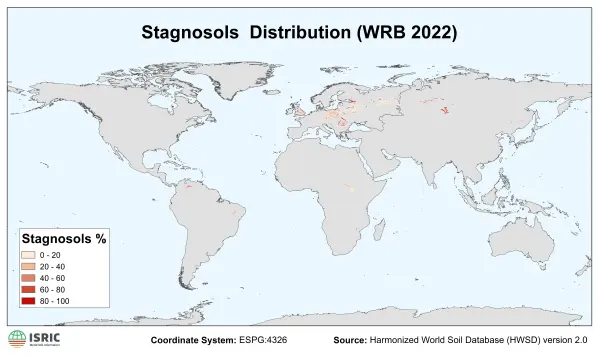
Stagnosols are often related to Luvisols and occur for the greater part in humid and perhumid temperate regions in West and Central Europe, North America, Australia and Argentina.
