Latvia and Estonia, 2017
The joint workshop in Latvia and Estonia brought attention to soils of boreal and temperate climates, including Podzols, Histosols, and Gleysols. Participants examined soils influenced by forest vegetation, high groundwater levels, and organic matter accumulation. The workshop emphasized the identification of hydromorphic features and the classification of organic-rich soils. Discussions focused on improving diagnostic criteria for wet and cold-region soils, as well as ensuring consistency in field descriptions. The excursions provided valuable opportunities to compare interpretations across similar landscapes in different countries. The meeting contributed to refining WRB guidelines for soils affected by waterlogging and organic processes, while strengthening collaboration among European soil scientists.
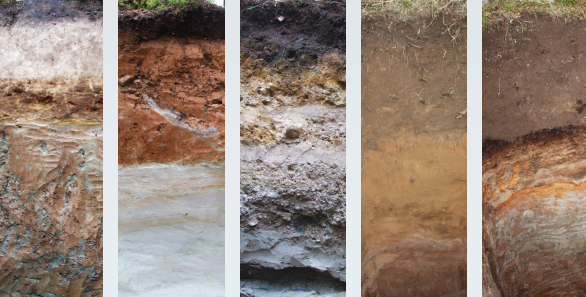
Soils are developed mainly on Late Weichselian glacial deposits (formed by loamy sand, sandy clay, loam, clay, gravel, sand) and altered to some extent by postglacial aeolian, marine, lacustrine, alluvial and mire sediments, as well as formed on pre-Quaternary sedimentary rocks. The soils show different organic surface layers: mull, moder, mor, amphi etc.
WRB guidebook International WRB Soil classifcation Field Workshop in Latvia and Estona